Foundation Education
An overview of why foundations settle, crack, and let in water, and how local clay soils affect homes like the ones in Portage la Prairie, MB.
Your foundation transfers the entire weight of the home down into the soil beneath it. As long as that soil stays stable and supports the load evenly, the foundation stays where it should. Problems begin when the soil moves, loses support in one area, or pushes against the walls, because the foundation moves with it.
Most foundation problems trace back to one of two root causes: soil movement beneath or around the foundation, and water. Very often the two are connected, since water is what makes soil expand, shift, and lose its load-bearing capacity in the first place.

Much of Portage la Prairie and the surrounding central Plains sits on clay-heavy soil. Clay is especially sensitive to moisture: it swells when it takes on water and shrinks as it dries out. This expansion and contraction happens seasonally and puts repeated pressure on foundation walls and footings, which over years can lead to cracking, uneven settling, and bowing walls.
This movement isn't a sign anyone did anything wrong. It's simply how these soils behave in this climate. It's also why foundation issues are common across this region and why an inspection, rather than a guess, is the right way to understand what's happening under a specific home.
Our long, cold winters drive frost deep into the ground, and frozen soil expands and pushes against foundations. In spring, melting snow and heavy rain saturate the soil around the home. When water builds up in the soil next to and beneath the foundation, it creates pressure that pushes on walls and forces water in through cracks, joints, and gaps around pipes.
This is why so many basements in Portage la Prairie and the central Plains take on water during spring melt or after a heavy rain. Poor surface drainage, downspouts that dump water next to the foundation, and a high local water table all make the problem worse by keeping more water against the foundation for longer.
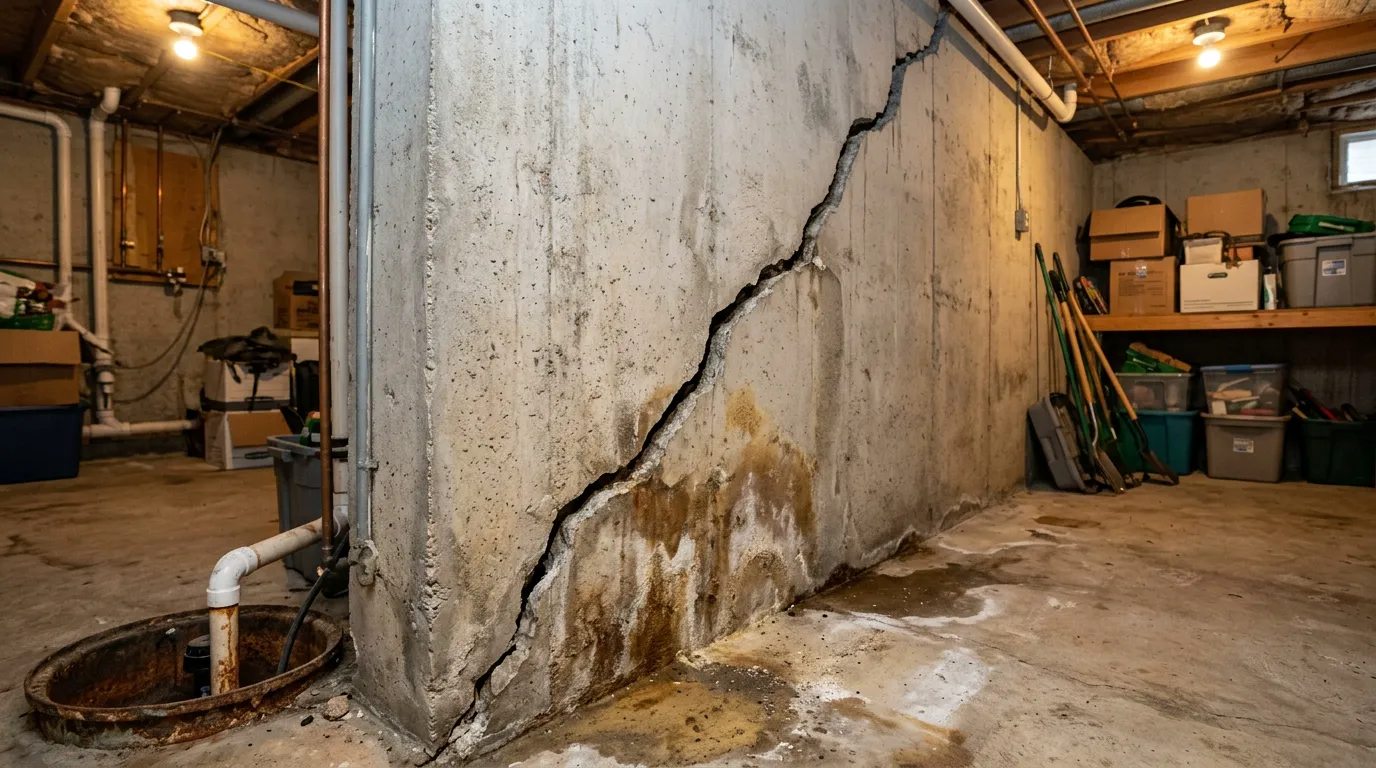
Common signs of a foundation problem include new or widening cracks in foundation walls or drywall, stair-step cracks in block foundations, doors and windows that begin to stick, floors that slope or feel uneven, gaps opening around window and door frames, and basement walls that appear to bow or lean inward. Water or dampness in the basement is another clear signal worth investigating.
Not every one of these means a major repair is needed. Some cracks are cosmetic and some movement stabilizes on its own. But because these signs can also point to an active problem that gets worse over time, having them inspected early is the safest way to know whether to repair now or simply monitor.
The combination of clay-heavy soils, deep frost, and seasonal runoff means foundation issues are genuinely common across Portage la Prairie and the central Plains. This doesn't mean every home has a problem, since foundation type, drainage, construction quality, and the soil directly beneath each home all vary from one property to the next.
What it does mean is that Portage la Prairie homeowners have good reason to take warning signs seriously rather than assume a home is fine simply because a crack looks small. A foundation problem is almost always cheaper and easier to address early than after it has been left to progress.
Get an honest diagnosis of what's happening under your home.
Call (431) 304-3213 Request a Free Estimate
Free, no-obligation estimate